The Writers' Journal9 September 2026
Écrivium: an all-in-one digital workspace designed for writers
From the first idea to connecting with readers, the platform brings together tools for writing, structuring a story, preparing for publication and managing an author career.
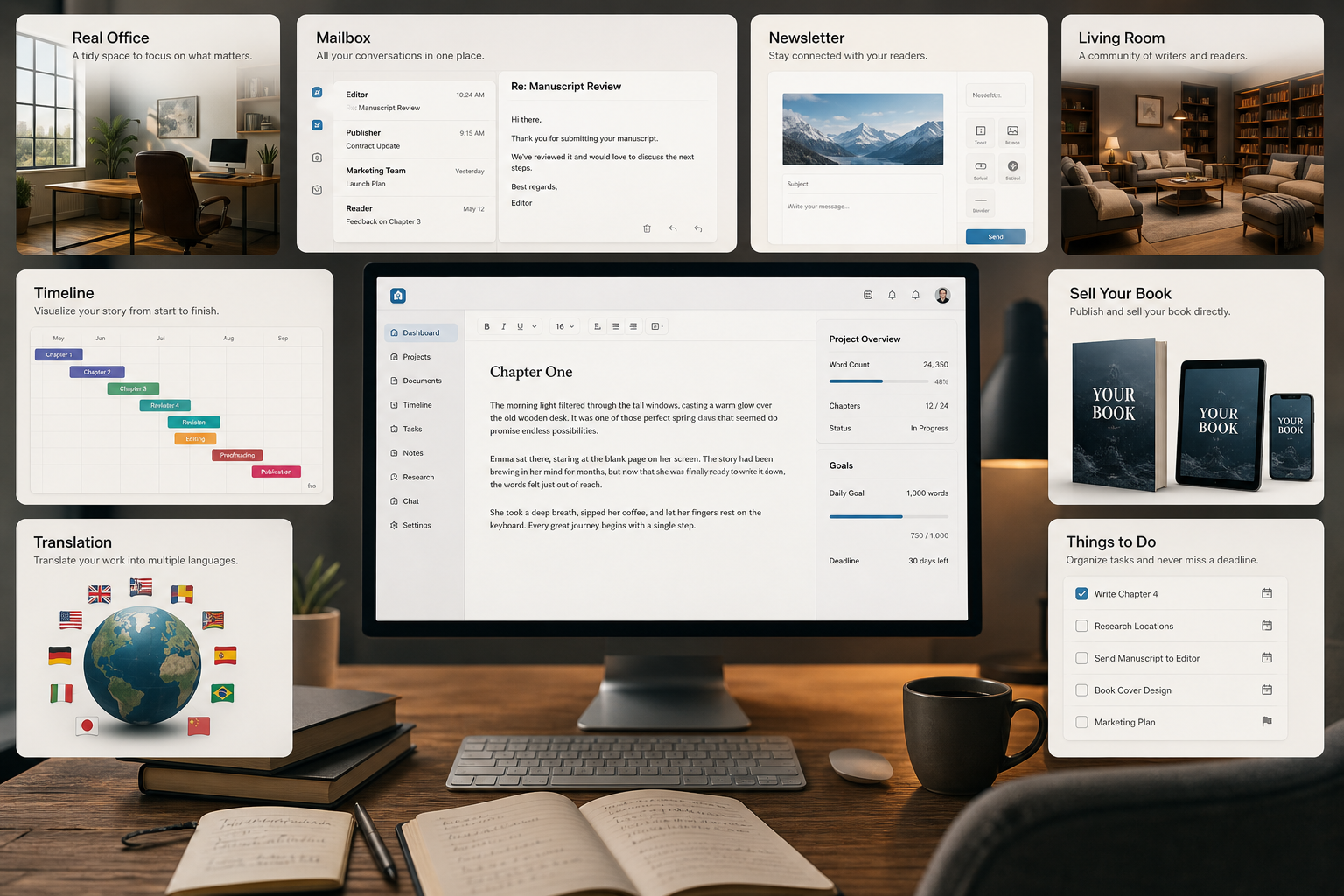
Writing a book involves more than filling pages. Authors need to preserve ideas, develop characters, check timelines, revise manuscripts, plan releases, communicate with readers and sometimes prepare translations. These tasks often leave their work scattered across several applications. Écrivium.fr is an all-in-one digital workspace for writers: an environment designed to bring together the different stages in the creation and life of a book without reducing writing to basic word processing.
A creative workspace for writing and developing a story
The manuscript remains at the heart of the writing process. Écrivium allows authors to write and organize their work chapter by chapter. This structure makes it easier to navigate a long project, whether it is a novel, narrative nonfiction, an essay or any other book that requires careful progression. Writers can focus on a specific section without losing sight of the book’s overall architecture.
A story, however, rarely develops solely within the document in which it is written. Early ideas may take the form of notes, relationships between characters, scenes that need moving or events that must be reordered. Mind maps help writers explore these connections and give visible shape to a project that is still evolving. They can be used to examine themes, subplots, a protagonist’s motivations or the different branches of a fictional world.
The timeline addresses another common challenge: keeping control of narrative time. In a story spanning several periods or involving flashbacks and parallel action, a chronology kept separate from the manuscript can reveal date errors and impossible sequences. It also allows the author to examine the intervals between events and check that character development remains believable.
Character and location profiles serve as the project’s reference library. A character profile can centralize the details needed to maintain continuity, while a location profile helps the writer quickly retrieve the setting of a scene. The aim is not to accumulate information for its own sake, but to keep useful details accessible and prevent contradictions during drafting and revision.
The story map, notes and consistency tools add further layers to this organization. They provide several ways to view the same book: the manuscript itself, its structure, its chronology and the information behind its fictional world. Keeping these elements separate is valuable. It prevents the manuscript from becoming overloaded with comments and reduces the number of hard-to-find supporting documents.
Artificial intelligence tools can also assist with certain stages of the process. They should nevertheless remain support tools. The author is always responsible for the voice, narrative choices, fact-checking and final decisions. An automated suggestion is only useful if it is reviewed, assessed and adapted to the literary project.
From publication to communication: managing the professional side of authorship
Finishing the first draft does not mean the work is over. Next come editing, preparing for publication, finding service providers, organizing the book launch and communicating with readers. For independent authors and writers following a traditional publishing route alike, these activities require time and a clear method.
Écrivium aims to bring these different aspects into the same environment. Its calendar and task-management tools can turn a broad objective—publishing a book—into identifiable stages. Authors can structure their work around revision, launch preparation, publication requirements and communication. This planning makes priorities easier to distinguish and helps prevent promotional responsibilities from continually encroaching on writing time.
An @ecrivium email address can help separate correspondence related to an author’s work from personal email. This distinction brings greater clarity to communication with readers, publishing professionals and potential partners. It can also contribute to a consistent author identity without requiring writers to use a private address for every professional enquiry.
The integrated newsletter addresses a related priority: maintaining a direct connection with readers. A newsletter can announce a new release, share progress on a project, publicize an appearance at a book fair or introduce readers to the world of a book. Its effectiveness depends less on sending frequency than on consistency, relevant content and respect for subscribers. A newsletter should therefore be treated not as a stream of advertisements, but as a recurring editorial appointment.
The module for translating books into several languages may help authors prepare their work for other markets. Literary translation nevertheless requires particular attention to style, cultural references, dialogue and narrative voice. Whatever tool is used, thorough human revision remains essential before publishing for a new readership.
The platform also provides information about book fairs, connections with printers and tools related to publication. These resources can help authors prepare more effectively for what follows the writing stage by comparing their needs, anticipating deadlines and identifying useful steps. Being connected with a provider does not remove the need to request details, review the proposed terms and verify that the service matches the required format, budget and quality standards.
A central hub that reduces fragmentation without replacing an author’s own method
The main benefit of an all-in-one digital workspace is continuity. When notes are stored in one application, the timeline in a spreadsheet, character profiles in separate files and the calendar somewhere else, authors spend part of their energy searching for, transferring and updating information. Bringing these resources into a shared environment reduces fragmentation and makes it easier to move from one stage to the next.
This centralization also applies to the collaborative side of writing. A community forum and discussions between writers can reduce isolation, encourage the sharing of experiences and provide opportunities to compare methods. Beta readers can offer an outside perspective on clarity, pacing, characters and manuscript consistency. To make beta reading genuinely useful, authors should ask specific questions: At what point does attention begin to fade? Are the characters’ motivations clear? Do any passages appear contradictory?
A shared workspace does not mean that every author must use every tool from the first day. A novelist building a complex world might begin with profiles, mind maps and a timeline. An essayist may prefer notes, chapter organization and a calendar. An author approaching publication may focus more closely on launch tasks, book fairs, printing and newsletters. The right digital workspace adapts to the project rather than imposing the same process on everyone.
To make effective use of Écrivium, it is therefore helpful to establish a simple workflow. The first stage might bring together the core idea, notes and a mind map. The second can organize the outline, characters, locations and chronology. The third is dedicated to drafting chapter by chapter. Consistency checks, beta-reader feedback and revisions then follow. Finally, the publication calendar, communication tools and community-building activities take over.
Before adopting a central platform, writers should also consider what they actually need. Are they working on one book or several projects? Do they require a detailed timeline? Do they want to build an ongoing relationship with readers? Are they preparing for publication, printing or translation? These questions help authors select the relevant features without turning organization into yet another burden.
Écrivium’s role is therefore not to write or make decisions on the author’s behalf, but to provide infrastructure that supports the author’s work. Creativity remains personal; the digital workspace supplies a framework, a reliable project memory and tools that help maintain continuity.